I absolutely love cool downs. In fact, do not get between me and my cool down. It’s one of the few times where I am not chatty – this is serious me time. However… not everyone feels the same way. So let’s have a closer and slightly scientific look at cooling down after climbing.
What is a cool down anyway?
Think of it as the graceful exit after the chaos of climbing. Instead of dropping off the wall, flopping onto your crash pad and eating your chalk-dusted apple, you take a few minutes to let your body slowly come back to baseline. A cool down usually looks like gentle movement, some easy mobility, and a bit of stretching.
And here’s the important bit: a cool down isn’t just about muscles — it’s also about your nervous system. Climbing fires up your sympathetic nervous system (your fight-or-flight mode). A proper cool down helps bring this down, nudging your body back into rest-and-digest mode. Translation: less twitchy, more chill.
It’s also a very important time to check in with your mind and body. How did that session actually feel? Are your fingers twinging? Is your head buzzing? A cool down gives you space to notice the little things before they become big things.
Why bother?
Here’s where it gets interesting.
Research says:
- Cool downs help bring your heart rate and blood pressure down in a gradual, safe way.
- They may speed up lactate clearance (that burny, pumped feeling).
- They improve short-term flexibility and, if you stick with them, long-term mobility.
- They help down-regulate the nervous system after intense activity, leaving you calmer and better recovered.
- Research suggests there’s indirect injury prevention through better mobility and more balanced muscle tension — important in repetitive sports like climbing.
- Sadly, the evidence that they directly reduce muscle soreness or prevent injury directly- is… meh. Some studies say maybe, others shrug.
Frankly, the hard science supporting cool downs is a little underwhelming.
But anecdotally:
- Climbers swear by them.
- They say they feel less stiff, recover faster, and avoid that “my forearms are made of concrete” feeling.
- Many find it’s also a great mental switch-off after a session.
At the end of the day, if you enjoy cool downs and they work for you, it seems you will get the benefits – even if they don’t have hard science behind them.
How long should it take?
You don’t need to carve out half an hour. Five to ten minutes is the bare minimum; ten to twenty minutes is ideal if you’ve trained hard. That’s basically one less scroll through Instagram – very doable.
Stretching – dynamic or static?
Here’s the deal:
- Dynamic stretches (moving stretches) are great for circulation and mobility.
- Static stretches (holding for 20–60 seconds) help with flexibility, but keep them gentle – no aggressive pulling, please.
You can mix them up depending on how you feel.
10 recommended and easy-to-start-with cool down exercises
These are just starter ideas. See what works for you, throw away the ones you hate, and shamelessly steal new ones from your friends. Attending a flexibility or yoga class could also be a good place to start.
- Walking or gentle jogging
- Easy climbing, super low intensity
- Wrist circles & mobility drills
- Forearm extensor stretch (fingers down)
- Forearm flexor stretch (fingers back)


- Cat-cow or thoratic rotations


- Thoratic Rotations

- Hip flexor stretch
- Hamstring stretch or forward fold / touch toes
- Shoulder cross-body stretch (place arms on both sides of the doorway and gently stretch forward)

So… worth it or waste of time?
So it seems that cool downs are more about the head than the body. If you like them and they work for you, you can absolutely benefit. But if you feel they are a waste of time… they’re probably a waste of time.
As for me? I’ll keep fiercely guarding my quiet, sacred, end-of-session ritual. Don’t mess with me when I’m cooling down – that’s when the chatty therapist switches off, and the zen climber emerges.

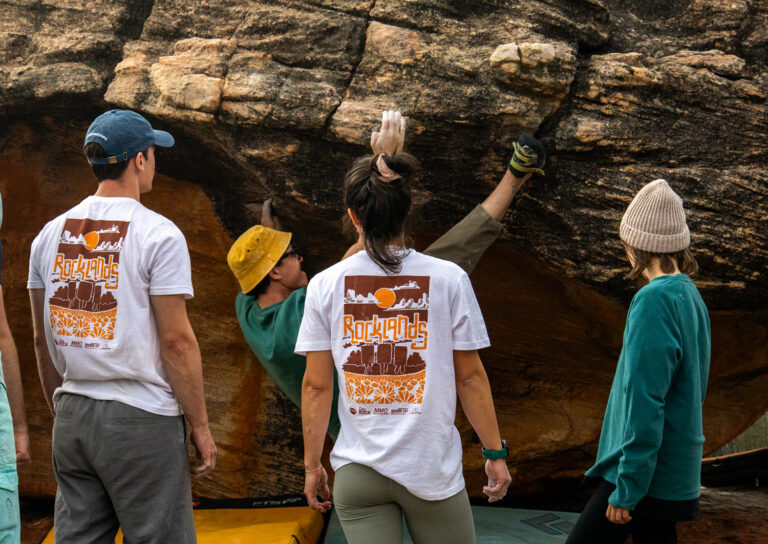
A true climbers usual cool-down, consisting mostly of chatter and coffee….

JENNI COMINS
Occupational Therapy
BSC OT (Wits)
Dip Hand Therapy (UP)
Practice no: 0595926
The Rehab Room
CityROCK – Johannesburg
46 Fourth Ave South, Fontainebleau
[email protected]
082 449 5782